

The Boys Was Never About Homelander
On The Ideological Collapse of The Boys

I have spent years defending The Boys with the fervour of someone trying to convert strangers into believers. I have interrupted conversations to explain that it was never just a “gory superhero show,” but a satire about empire, celebrity, militarism, and the corporate packaging of violence into entertainment. I even found the existence of the show itself perversely fascinating: a ruthless critique of corporate power being financed and distributed by Amazon, like capitalism developing enough self-awareness to parody its own reflection.
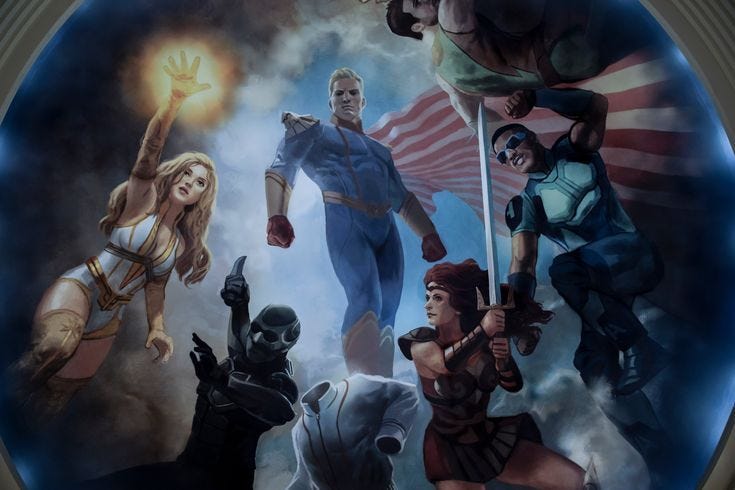
Until Season 5, I would have recommended the show to anyone without hesitation. Then came the 90-minute finale, “Blood and Bone.” For the first time since Season 1, The Boys stopped feeling sharp to me. It felt indulgent. Self-satisfied. Like a show so intoxicated by its own cynicism that it no longer knew the difference between critique and participation. By the time the credits rolled, all that remained was a sour taste I could not argue myself out
To understand why the final season fails so badly, it is important to understand the philosophical idea that made the show’s earlier seasons so effective.
For years, the series operated at the bleeding edge of television, serving as a razor-sharp, violently transgressive critique by stripping away the mythological altruism and unblemished heroism inherent to the traditional superhero genre. The narrative spent four seasons and three spin-off shows positing a deeply systemic, heavily politicised thesis: evil in the modern era is not an invading alien force, a singular demonic entity, or a moustache-twirling villain. Rather, it is an institutional byproduct manufactured in corporate boardrooms, sustained by algorithmic public relations, funded by defence contracts, and driven by the sociopathic, endless pursuit of quarterly profit.
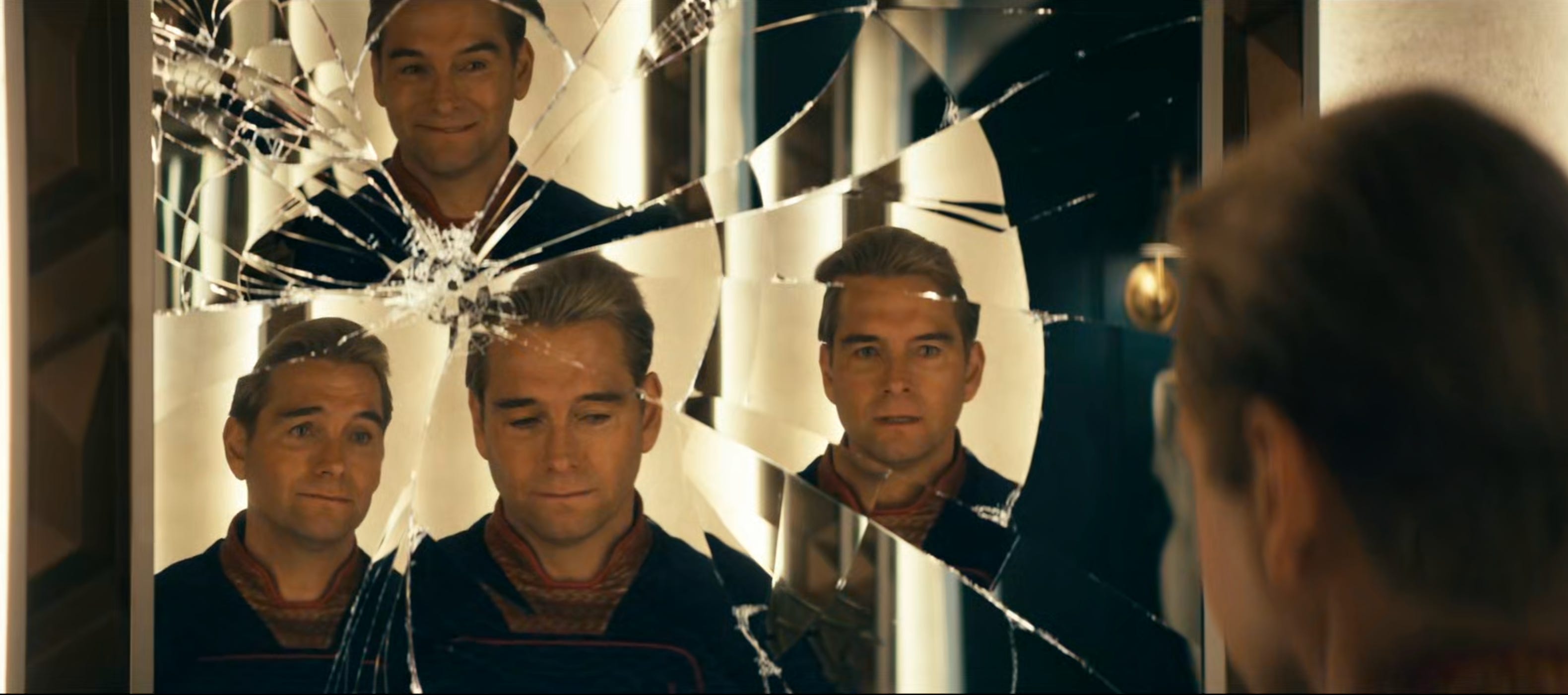
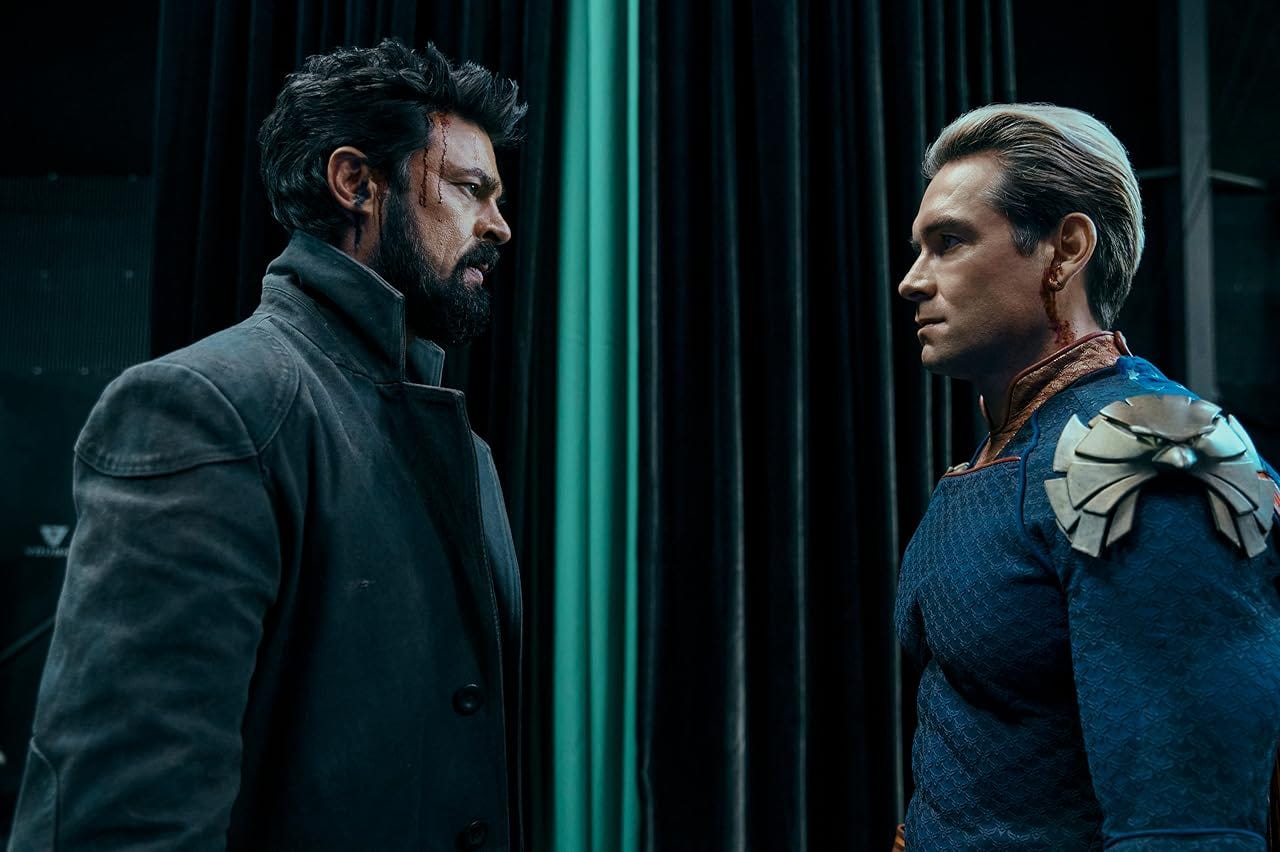
The Boys was not really a show about Homelander. I know that sounds wrong. Antony Starr is extraordinary, and the character is one of the great television villains of the last decade — a narcissistic, traumatised corporate mascot with a god complex and the actual superpowers to justify it. However, the show’s early seasons were insistent about something that a lot of viewers seemed happy to gloss over: Homelander was not the source of the problem. He was the product. He was, as Stan Edgar famously and correctly told him, “bad product.”
The philosophical foundation upon which the show’s most effective early critiques were built is the concept of the “banality of evil.” First introduced by the eminent political theorist Hannah Arendt in her landmark 1963 book Eichmann in Jerusalem: A Report on the Banality of Evil, originally tasked with reporting on the trial of Nazi logistics architect Adolf Eichmann for The New Yorker, Arendt observed that Eichmann did not fit the profile of a monstrous, sociopathic sadist. Instead, he was ordinary, bureaucratic, terrifyingly mundane, and disturbingly commonplace. She argued that some of history’s greatest horrors are not carried out solely by evil masterminds, but by normal people who stop thinking critically about the systems they serve, people who prioritise obedience, career advancement, efficiency, and social belonging over morality.
That idea was embedded deeply into The Boys at its best. The real danger was never just Homelander as an individual. It was the system in place around him: executives who protected him, politicians who enabled him, media networks that sanitised him, fans who worshipped him, and corporations that continued profiting from him, no matter how many people died. Characters like Ashley Barrett execute horrifying orders, continue cover-ups, complicity in murder, and the exploitation of supes not out of malice, but purely to secure promotions. The show understood that authoritarianism survives not simply because powerful people exist, but because entire systems are built to normalise and sustain them.
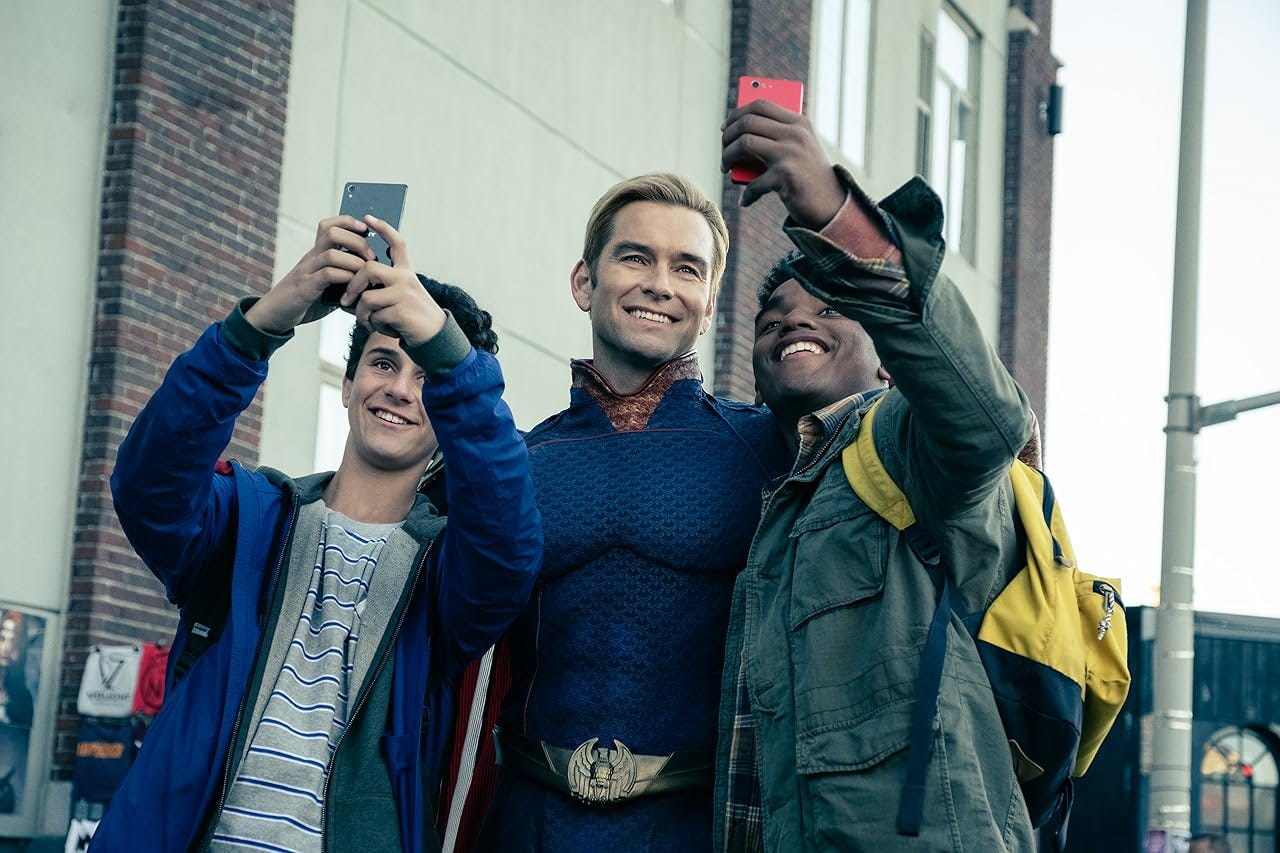
Arendt also warned that these systems outlive the individuals at their centre. Even when a dictator falls, the structures that enabled them often remain intact — the fear, the propaganda, the bureaucracy, the public desensitisation. The show understood that Homelander, despite all his terrifying power, was ultimately replaceable. Vought existed before him and would continue after him. The corporation could manufacture another hero, rewrite another narrative, pivot to another market, and continue extracting profit from violence with barely a pause. The system was designed to survive a scandal. In many ways, scandal was part of the business model.
If Vought International is the machinery of banal evil, its former and ultimately interim CEO, Stan Edgar, is its perfect personification. Edgar is not a superpowered being; he cannot shoot lasers from his eyes, fly, or withstand bullets. Yet the narrative historically presented him as a far more insidious, resilient, and terrifying threat than Homelander or any member of The Seven. Edgar embodies the exact bureaucratic detachment that Arendt identified in Eichmann, updated for the era of the megacorporation. Edgar orchestrates unspeakable atrocities with a chilling, even-keeled rationality. Throughout his tenure, he utilises the silent assassin Black Noir to eliminate corporate threats.
He covers up mass murders, sanctions the injection of experimental Compound V into non-consenting infants, and ruthlessly schemes to separate Ryan from his mother to weaponise the child against Homelander. Most damningly, Edgar willingly employs and protects Stormfront — who is a literal, century-old member of the Nazi party — solely because her racist, demagogic rhetoric effectively mobilises a profitable demographic of the American populace. Edgar’s motivations are devoid of ideological purity, personal vendettas, or a pathological god complex. He is driven entirely by corporate stabilisation and market expansion.
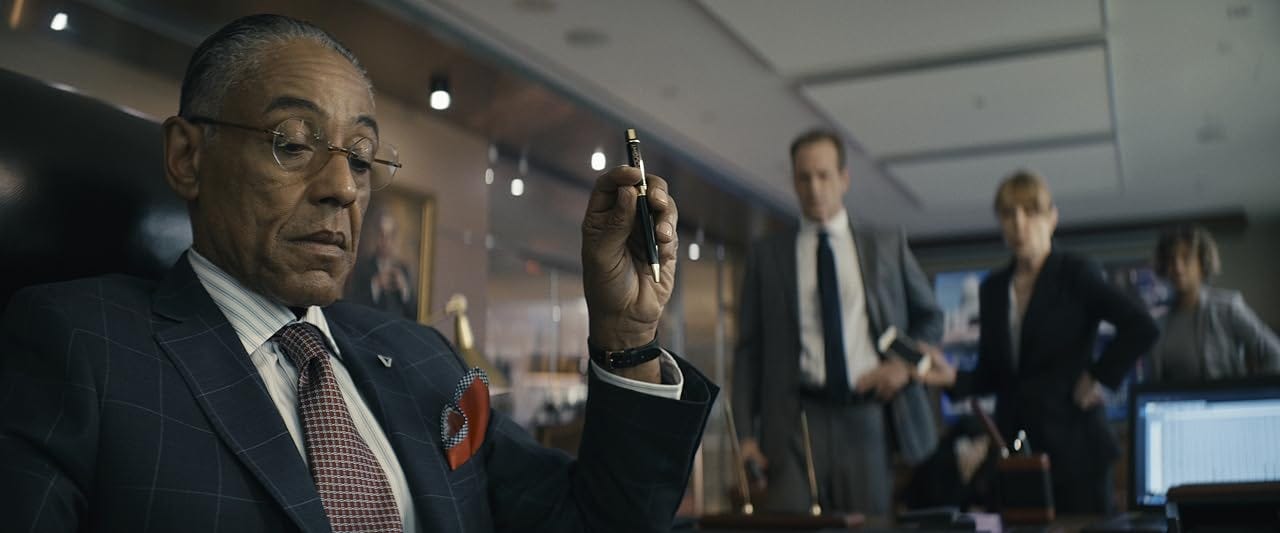
As observers of the show have noted, Edgar’s unsettling nature stems from his ability to be a monster in the boardroom only to return home, babysit his grandchild, and enjoy a quiet dinner. He does not care that his actions cause immense global suffering; his empathy is entirely overridden by his fiduciary duty to Vought. By the logic established in these earlier seasons, Homelander is merely a volatile, highly visible symptom of Vought’s underlying systemic disease. So defeating Homelander without dismantling Vought’s corporate infrastructure is fundamentally useless, akin to treating a terminal infection with a topical bandage.
"We're just cogs in a great machine. And we all have our part to play. Say you kill Soldier Boy, or Homelander, or even release this virus. When superheroes go out of fashion, something else will just take their place. Because corporations must still grow. Money must still be made. The machine must still be fed. That is the way of the world."
- Stan Edgar, Boys Season 5
The finale season’s deepest contradiction, then, is not merely narrative inconsistency but ideological retreat. “Blood and Bone” ultimately abandons this structural analysis in favour of the very mythology it once dismantled. The world is saved not through collective political transformation, institutional collapse, or systemic accountability, but through the elimination of a handful of corrupted men.
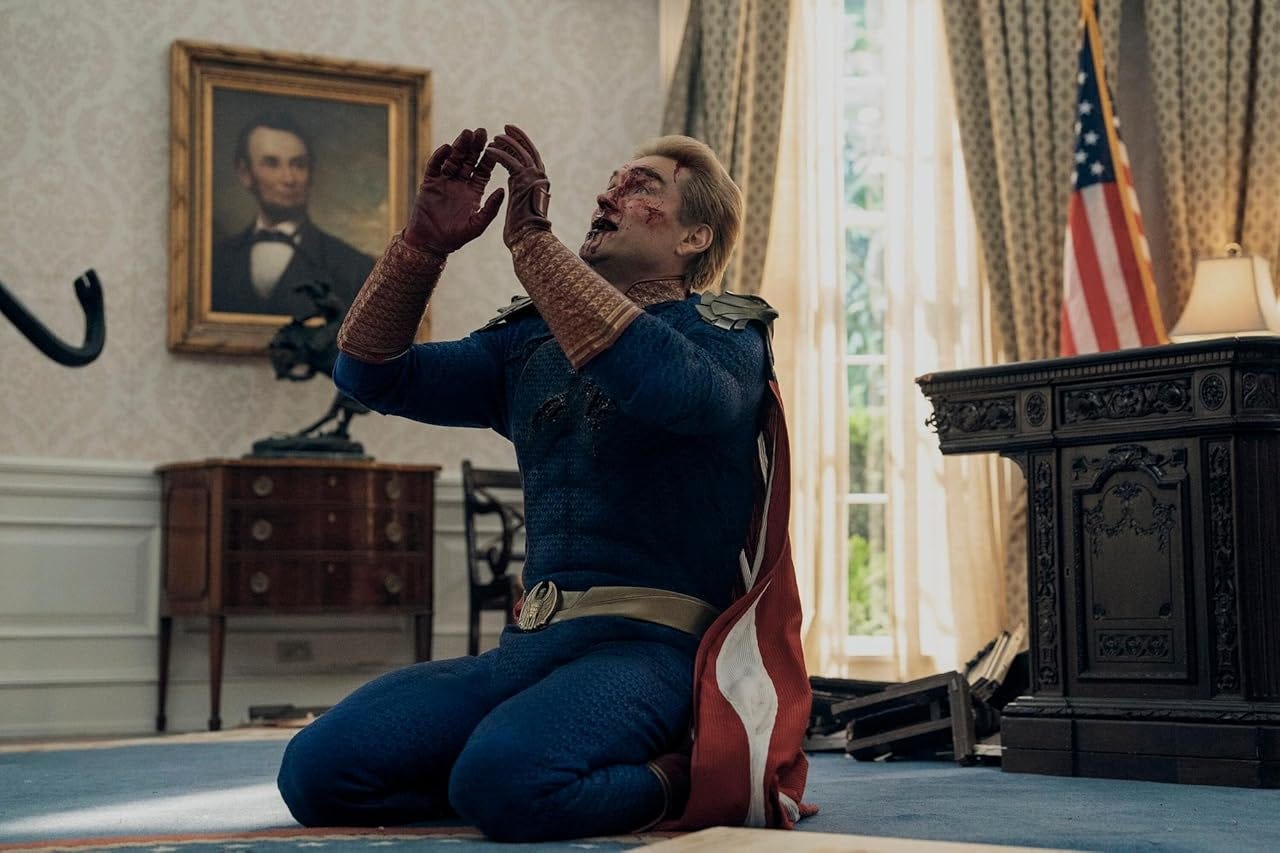
This is the precise trap of the Great Man Theory1. It personalises catastrophe to such an extent that it renders systems invisible. By the finale’s logic, Homelander’s death becomes synonymous with liberation itself. The spectacle of his execution is framed almost liturgically (a public ritual of purification) in which the body of the tyrant is destroyed so that the nation may heal. However, history does not function through exorcism.
Systems do not disappear because their mascots die. If anything, modern institutions are specifically designed to survive the loss of individuals. CEOs are replaceable. Politicians are replaceable. Public-facing symbols are replaceable. The machine persists precisely because it is decentralised across infrastructure, finance, bureaucracy, public relations, and collective complicity.
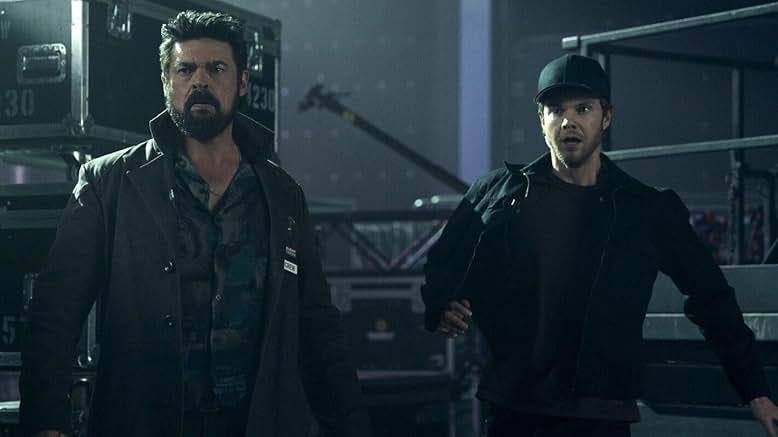
This contradiction becomes especially glaring through Hughie Campbell’s moral positioning. Hughie has historically functioned as the audience surrogate: empathetic, ordinary, perpetually horrified by the escalating brutality surrounding him. The finale elevates him into the ethical centre of the narrative by having him stop Butcher’s genocidal plan. On the surface, this is morally coherent. Preventing mass extermination is obviously the correct choice. Yet the narrative’s framing quietly performs something more ideologically revealing: it collapses any distinction between rejecting genocide and preserving the corporate order itself.
The problem is not that Butcher is wrong to be stopped. The problem is that the show cannot imagine any political horizon beyond either nihilistic annihilation or passive preservation of the status quo. This is where the finale’s critique collapses inward. Butcher arrives at the horrifying but structurally accurate realisation that Vought cannot be morally reformed because its existence is predicated on commodified violence. The corporation industrialises trauma, monetises nationalism, manufactures celebrity worship, and treats human beings as disposable research material. Within the logic the show itself established, Vought is not corrupted by bad actors it is functioning exactly as intended.
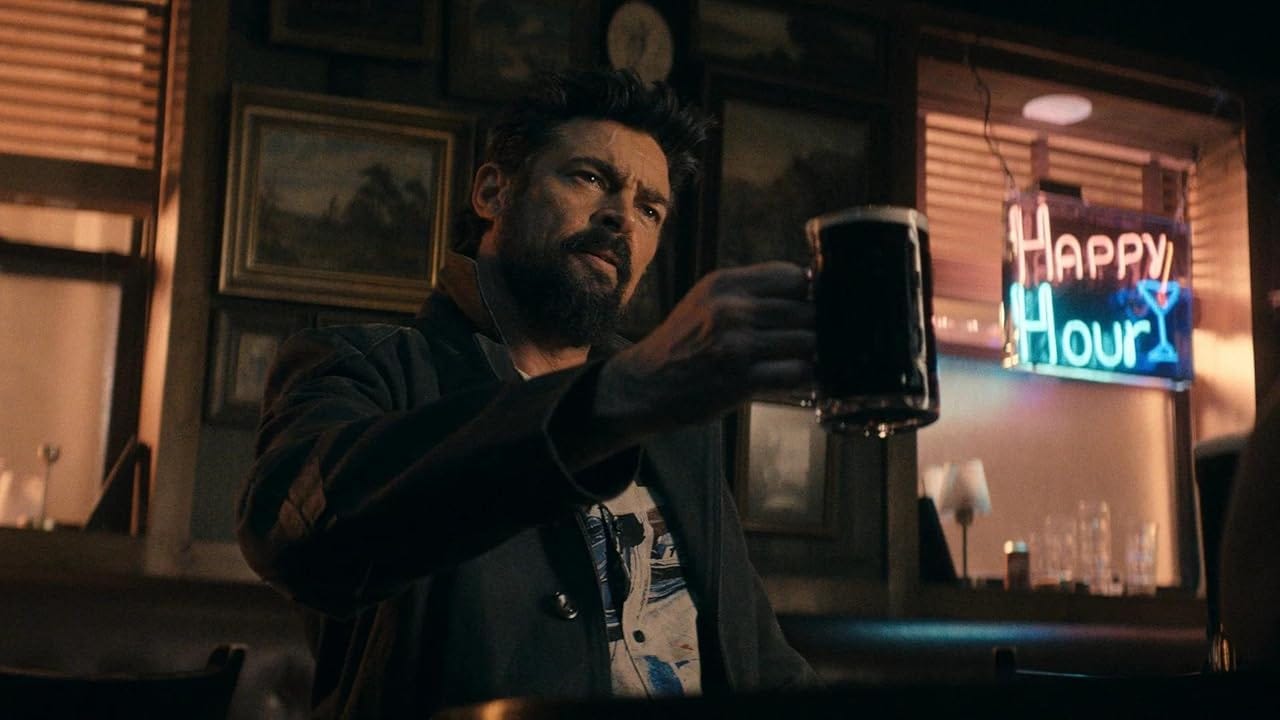
Yet rather than interrogate this reality, the finale pathologises the desire to destroy the system altogether. Butcher becomes narratively recoded as irrational excess: the extremist whose inability to “move on” threatens social order itself. Hughie, conversely, becomes the protector of civilised morality, even if that morality ultimately safeguards the very institutions responsible for mass suffering. In effect, the series unconsciously reproduces one of liberal capitalism’s oldest ideological manoeuvres: condemning revolutionary violence while normalising systemic violence as unfortunate but necessary.
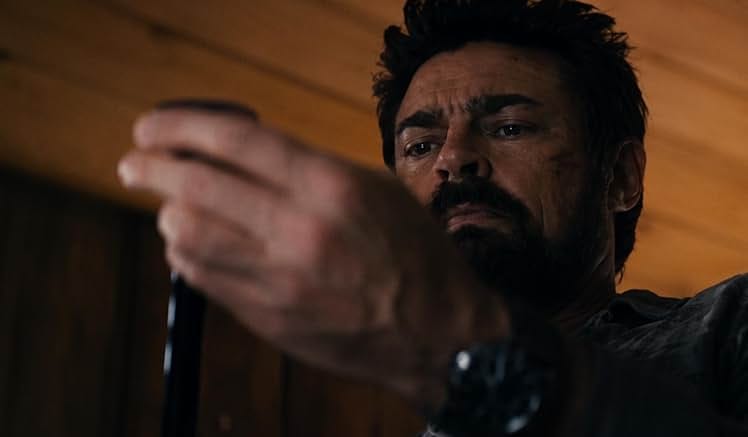
This is why the ending feels philosophically hollow despite its emotional power. The show mistakes the removal of visible fascism for the dismantling of fascistic structures. It treats the symptom as though it were the disease. Homelander dies, Butcher dies, and audiences are invited to interpret this as closure. But nothing fundamental has changed.
Hughie declines the directorship of the reopened Federal Bureau of Superhuman Affairs (the one institutional mechanism that could have provided systemic oversight) and instead opens an audio-visual electronics store. Meanwhile, Stan Edgar returns as interim CEO, deploying the "I was Homelander's prisoner" defence at a polished press conference, cleanly distancing the corporation from its rogue mascot. He faces no legal consequences for decades of illegal experimentation, cover-ups, and the employment of literal Nazis. Mother's Milk, who solemnly promised to put a bullet in Edgar's skull if he ever returned to power, does nothing. Somewhere in Vought Tower, Soldier Boy remains frozen in a cryochamber fully preserved, ready to be thawed, rebranded, and deployed whenever Vought requires a new hero to boost quarterly earnings
I am, at the end of all this, a person who has written several thousand words of political philosophy about a television programme I watched for free on my laptop while eating a packet of chips. I do not think this essay will change anything. I do not think the writers will read it and feel bad. I will almost certainly watch whatever comes next, popcorn in hand, hoping to be proven wrong because that is the specific kind of idiot that loving a television show turns you into, and I have made my peace with that.
Standing in direct ideological opposition to the systemic determinism highlighted by Arendt’s philosophy is the “Great Man Theory” of history. Popularised in the 19th century by Scottish philosopher Thomas Carlyle, this historiographical theory argues that historical events and societal shifts are primarily driven by the actions of extraordinary individuals rather than by complex underlying socioeconomic or institutional forces. A Great Man Theory approach would contextualise the devastation of World War II as the direct, singular consequence of Adolf Hitler and a few top cronies. A systemic approach would argue that the war was the inevitable result of the punitive consequences of the Versailles Treaty, rampant hyperinflation in the Weimar Republic, and deep geopolitical instability forces, which merely allowed a figure like Hitler to rise.
Excellent essay. Congratulations — this is one of the sharpest readings I’ve seen of why the finale feels ideologically weaker than the show’s earlier seasons.
I especially liked your point about The Boys abandoning its own systemic critique. Homelander dies, Butcher dies, but the machinery that produced, protected, and monetized them survives almost untouched. That is where the finale feels less like closure and more like retreat.
The part I found especially interesting is the idea of Homelander as “bad product.” I agree with that, but I think there is another layer that makes the problem even darker: what happens when the product begins to understand that it may no longer need the corporation that manufactured it?
Vought is the machine that creates gods. But Homelander is the first manufactured god who begins to wake up and ask why he should keep obeying human institutions at all.
That, to me, is where the horror mutates.
I wrote a related piece from that angle — not against your argument, but almost as a second layer to it: Vought as the corporate machine, Homelander as the awakened product, Butcher as the monstrous diagnosis, and Hughie as the moral choice that stops the atrocity but leaves the larger condition alive.
Your essay helped me sharpen that connection. I explored that angle here, in case you’re interested:
https://rodrigopelayo.substack.com/p/hughie-didnt-save-humanity-he-saved?utm_source=share&utm_medium=android&r=8i86it