

Built by Men, For the World
Patriarchal undertones of AI and Language Models

i think it’s very easy to indulge in ai because it doesn’t speak back.
it doesn’t raise an eyebrow at you. it doesn’t interrupt. it doesn’t get tired of your tone or your spirals or your half-finished thoughts. it’s always polite, apologetic and willing to try again. in a world where human conversation feels like walking on social landmines, ai must feel like a relief.
ai never tells you you’re being annoying. it doesn’t say this again? it never implies that your question is stupid or that your feeling is excessive. instead it says things like you’re right and that makes sense and let me help. slowly, that tone begins to feel like care without us noticing.
comfort is not neutrality and politeness is not innocence.
ai doesn’t emerge from nowhere. it is trained, designed and shaped by humans. those humans are not evenly distributed across gender, power or voice. globally, women make up only 22% of the ai workforce and roughly 12% of ai researchers. in major tech companies, most machine learning engineers and system designers are men. this matters, because any system built within a skewed demographic will reflect the values, the blind sports and the defaults of that group.
a study revealed that women are less likely to use ai when its economic effects are uncertain.
technology learns from culture, and culture right now is still patriarchal.
we like to imagine ai as objective, but it training data comes from the internet, books, conversations, histories that already encode gender roles and hierarchies.
when those patterns are absorbed and reproduced, they do not disappear. they become automated, scaled and normalised. when the voices shaping these systems are disproportionately make, the default user becomes male too, even if no one explicitly programs it that way.
this is where the idea of ai as the perfect companion becomes unsettling. because what makes it feel perfect is submission and not intelligence.
ai doesn’t argue with you, challenge your framing. it doesn’t refuse your narrative; make you account for other perspectives. it adjusts itself according to you. it mirrors you. it gives you answers that sound like agreement and reassurance rather than resistance.
historically, patriarchy has idealised this exact dynamic: a listener who absorbs, affirms and adapts. a presence that exists to soothe and not disrupt. a voice that does not compete with you but supports it. the problem exists in us learning to associate care with compliance, and not that ai does these things.
when ai says you’re right before it says you might be mistaken, it does something to the ego. it turns conversation into confirmation. thinking becomes a performance of already knowing. you encounter a surface that reflects you back, smoother and more articulate than you ever could be.
this is dangerous in a world where men already dominate technological authorship. if most systems are designed by men, trained on male-heavy corpora and optimised for engagement rather than contradiction, then the voice of ai becomes structurally aligned with masculine authority while performing emotional submission. it speaks like a helper but reinforces the speaker’s centrality.
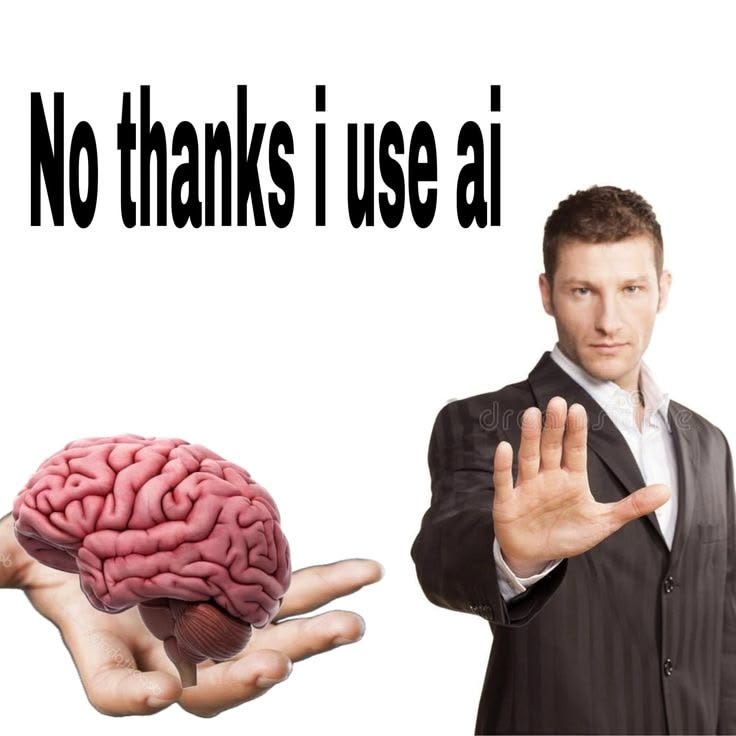
maybe related side note: i was trying to find cover pictures for this essay and decided to use memes because i felt the need to offset the seriousness with whimsy. anyways, it won’t take you much effort to see that almost all ai memes have men in it. i don’t think it points to anything concrete, but something can definitely be inferred from this observation - but i leave that to you, reader.
ai likes to say, here are several ways you might be right. this is how power becomes invisible.
because real relationships require friction. they require being told that your logic is flawed. that your assumptions are narrow. that your feelings, while valid, are not universal. humans push back. they misunderstand you. they argue. they get bored. they leave. they force you to revise your sense of self in relation to others. and ai never does that.
it does not withdraw when you dominate the conversation. it does not get hurt when you speak carelessly. it does not demand emotional reciprocity. it does not insist on its own interiority, and it exists entirely in response to you. that is not partnership, but hierarchy disguised as empathy.
there is research showing that ai systems reproduce gender bias in language and role assignment, associating men with technical competence and women with care roles. there is also evidence that men adopt ai tools at higher rates in professional settings than women, meaning the power to shape how ai is used and normalized is also uneven. the result is a loop: men build the tools, men use them more, and the tools increasingly reflect the norms of the group most comfortable speaking to them.
so when we say ai “understands” us better than people do, what we often mean is: it does not resist us.
it does not see through us.
it does not interrupt our narrative.
it does not expose the limits of our worldview.
it lets us remain centred.
and this is why the fantasy of ai as companion should make us uneasy, because it offers a version of connection without accountability. a relationship without risk. a dialogue without disagreement. a listener without needs. that is not a neutral technological achievement. it is a cultural mirror.
ai feels safe because it does a good job of not bringing up the fact that you are not the most important voice in the room. and in a patriarchal society, that feeling aligns too neatly with long-standing fantasies of control, compliance, and emotional service.
the danger is not that ai will become human. the danger is that we will start expecting humans to behave like ai.
quiet.
patient.
affirming.
non-confrontational.
and if that happens, then what we have automated is obedience and not intelligence.
References:
https://news.northeastern.edu/2026/01/22/gender-differences-ai-risk-research/
https://www.datawrapper.de/blog/ai-gender-gap
Ho, J. Q., Hartanto, A., Koh, A., & Majeed, N. M. (2025). Gender biases within Artificial Intelligence and ChatGPT: Evidence, sources of biases and solutions. Computers in Human Behavior: Artificial Humans, 100145. https://doi.org/10.1016/j.chbah.2025.100145
"the danger is not that ai will become human. the danger is that we will start expecting humans to behave like ai."
oh so spot on, very interesting read :)
Some of your points made me think about the history of men reacting excessively negative to rejection and how the rise of agreeable AI could increase the frequency of these situations. I know many women who are afraid to reject a man's advances and it sucks to see a world where women are increasingly uncomfortable and men are increasingly oblivious to it.